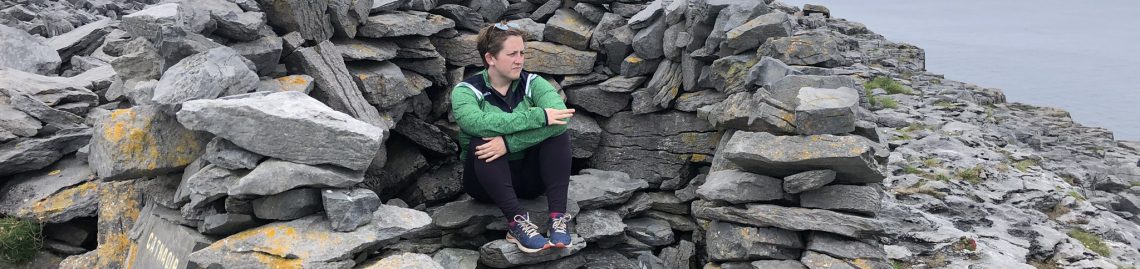

I never had an interest in learning a second language. Or a third. Many native English speakers go their entire lives without encountering anything significant they can’t do or get in their language; pure linguistic privilege, supercharged by colonialism and the resultant mowing down of minority languages1. Not that I knew any of that in school; I simply had little interest in French, and less in Irish.
Now I think about language a lot. Not about words per se, but how we say what we say and what that says about us. What of us is conveyed in our accents, dialects, colloquialisms and the banks of words we retain. I wonder about the notion of fluency, whatever that is. I think of all of this Irish I have, and how I got it, and what I’ll do with it.
And how it came to mean so much to me.
Languages are – at their most basic – systems to communicate needs. Such needs vary from person to person, from place to place, thus ‘languages differ essentially in what they must convey and not in what they may convey’2. What needs conveying in a sub-Saharan language differs from what needs conveying in an Inuit language, for example. Our forefathers lived close to the land and talked about a lot it appears, and thus Irish has at least thirty-two words for field?3
Dialects are like badges, while every accent adopted, retained, lost or neutralised has a story or reason behind it. A colloquialism is a mini social history; a feeling, tendency or attitude so prevalent in a community that a phrase needed inventing for it, a phrase that might not have travelled further than the next town or county.
For those of us learning and living in a second language, the words and phrases that stick are those most necessary, but everyone’s ‘necessary’ is different, making maps and diaries of our vocabularies. So though I have forgotten more than ever I will remember – but having done so on an offshore island – I know the Irish for periwinkles, I can identify and name winds and I’ve a list of words as long as my arm to describe motion in the sea. Indeed, even the decision to commit to the Irish says something, as everyone there has English and nobody would’ve batted an eyelid if outside of work I’d never spoken a word of Irish.
Now, before I continue, it is important to note that my Irish is ‘grand’. It’s C1 or C2, I’m a proficient speaker with weaker written Irish. I thought fluency was flawless expression and so never described myself as such, but I’ve since learned that fluency is merely being able to express oneself easily and articulately and well, I can do that.
It hasn’t always been the case.
There’s been a considerable improvement since August 2020, which came in two ways. The first; ingesting and digesting masses of words; listening, recording, writing down, repeating, using and heeding their use until they could be processed and produced at speed – a cycle that never stops because there’s always more to learn. I learn rules off by heart, I write reams of drills and exercises4, I stick PostIts on the bathroom mirror for studying while brushing my teeth, I WhatsApp myself new phrases and words as I hear them, I listen to the same show every morning on Radió na Gaeltachta, and I stick a sheet of paper over the subtitles on TG4.
The second is the daily usage; listening, speaking, asking, repeating. That was facilitated by my job certainly, but most of all by islanders who never spoke English to me. The man who collected me at the pier on my first day, asked me had I Irish and when I said I’d a bit, told me that was the last of the English he’d speak to me so. The patient ones who didn’t revert to English when my face was at its blankest. Those who repeated themselves, spoke slower and rephrased what I’d missed instead of just saying it in English. Those who didn’t have the English for just saying it in. Those who took the time to gently correct my mistakes.
And it was all those chats – those interactions, those pints in the pub and chats on the road – that made Irish personal to me. Language borne of the island, island begotten of the landscape, and me with a foot in each and the tongue of both. All three to me, entwined and inseparable.
A landscape where vocabulary hangs in the air like pollen in summer and ears are sung to always. People I’ve known only through Irish and all we’ve talked of; the geography, the stories, the poems, and the million conversations I’ve had about who is related to who and how. A language imparted to me in measures of small treasures; gifted to me like gems, usually with a pleased seo focal nua duit. Such words like precious Polaroids, for when I use them I remember who gave them to me and where we were; I got murach walking out of Hyde Park after Galway beat Roscommon, plobach at the seanchéibh of a radiant spring day, uaine and breathnaigh on my first day in the school.
And perhaps because of them or all the above, I worry that my Irish won’t survive a move. That it’ll fade to memory, to languish in the realm of all that gets left behind. That I’ll be too damned lonely for here to use it there, that I’ll wince at its use on pavements grey, or under starless nights. That I’ll resent vapid small talk after the conversation I’ve known here. Or, worst of all, that nobody in a gaelscoil will give me a job and there’ll be nobody to speak it with on a daily basis.
That it’ll have become too personal.
It was the notion of living on an island that drew me to Inis Meáin in August 2020; improving my Irish would be an added bonus, along with getting fit and writing more. I’ve written plenty and am fit enough and happy with both, but it is the Irish and the experience of living the other language that will stay with me. Like a tattoo, or a legacy.
Or simply, a gift.
- The Guardian, ‘Disappearing tongues: the endangered language crisis’ 22 February 2024 ↩︎
- ibid ↩︎
- Manchán Magan’s Thirty-two Words for Field is beautiful in this regard, particularly in explaining the centrality of the landscape in the Irish language ↩︎
- Gaelchultúr is the best place to learn Irish, and I couldn’t recommend their Gramadach gan Stró course highly enough ↩︎

 doireann.ie
Really really lovely, and how fortunate you are to be there
LikeLike