
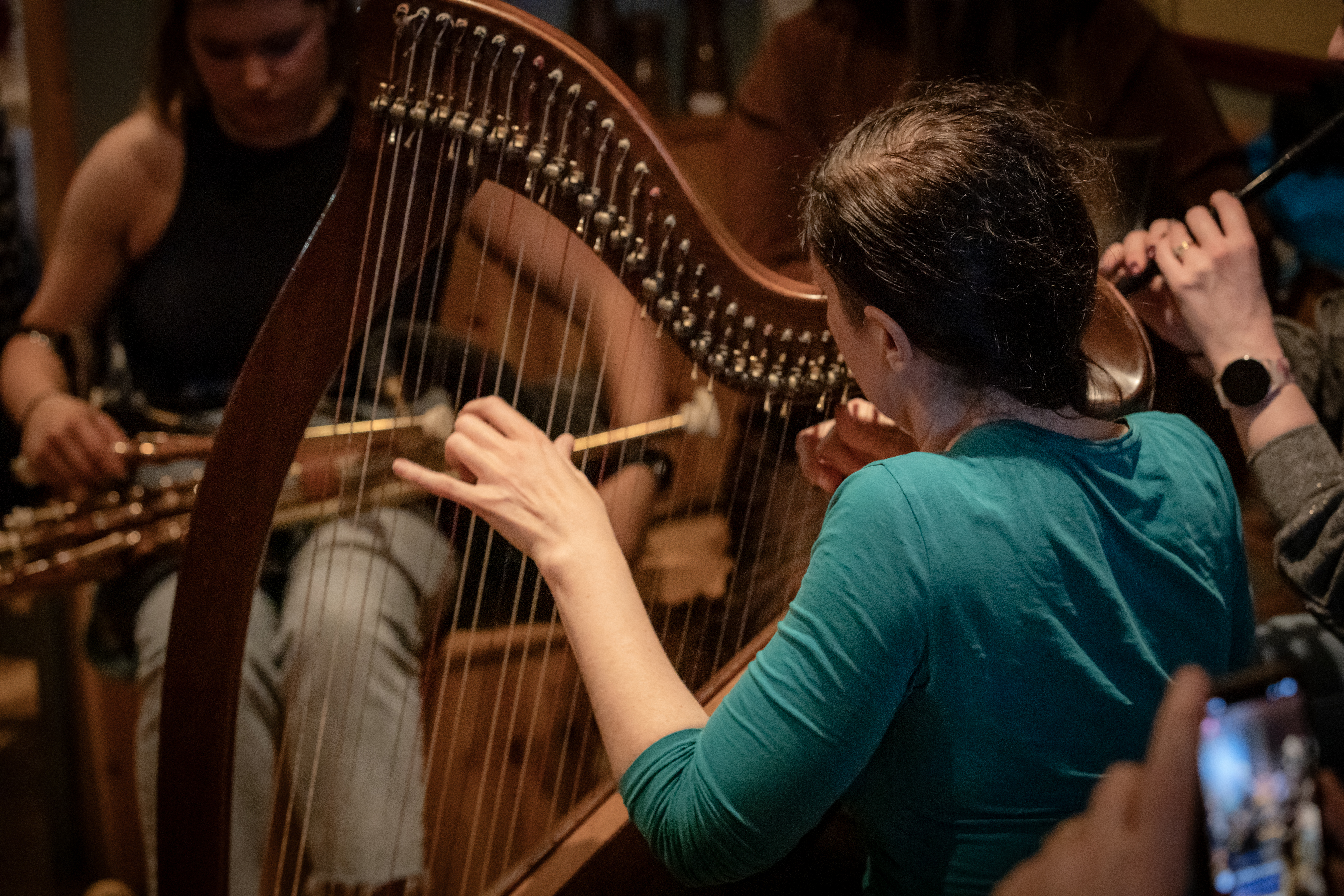
Photo Credit: Cormac Coyne.
…and he sang a stony music that asked its listeners to stay quiet and lean inwards[1].
At first, the music was so faint I inclined to sniff for it. Wisps of breezes often bring us scents, but rarely music. It was a June evening in the west village, broad and softly pink, and I was sitting on the edge of a stone trough chatting, when the sound of a seisiún ceoil wafted up the island, its music carried far and wide as windborne seed.
Where else would it happen, where else could I hear it and heed it?
It’s classical music I have, and even that I don’t have by ear. Much of my experience of traditional music is borne of the Friday night seisiúin that started about a year after I came here. I know little of genre, couplet, timing or style, but I know of effect and wonder, for wondered at it all have I. At talent, expression, and the enigma of how it all landed here. At the miracle of sounds made that show us ourselves.
Recently, near the house, three ox-eyed daisies appeared out of a November nowhere. I passed them every day for a fortnight, noticing them, seeing their subtle changes. I’ve swam and socialised with the Friday night group most days for three years, so when we gather in that corner of the pub of a Friday, I can see the subtle changes of the music in them. I see it across their faces when they sing particular songs, chorus and verse in chest and shoulders. Head sway and incline. Hands wrung. A verse that narrows the eyes, the line that shuts them. The slight daze when done, a sheepish smile, the split second of surprise at returning to where you didn’t know you’d left.
The songs we sing, the tunes we choose, are expressions of who we consider ourselves to be. They’ve been inherited or collected, selected for resonance, rehearsed to do justice to the sentiments they stir, to the memories they awaken. Those songs, sung from wherever feelings are created and kept, are performance as extension of the performer. I sing The Foggy Dew sometimes, and I’ve done my best versions of it a thousand winds away, as down a glen one Easter morn to a city fair rode I.
A review of Song of Granite in the Irish Times spoke of sean nós as a music “that asked its listeners to stay quiet and lean inwards”. As much as I love to listen to music, I love to lean inward and just watch it being made, watch what it does.
There’s nights I’ll sing, but others too where just I’ll sit and observe. Watch the dance of dextrous fingers across a harp, the nods and tips of head that translate intention into glorious sound. The sweet fluidity of tin whistles played well. A warrior princess with the uileann pipes, a revelatory bodhrán. Earned silence, a mesmerised room viewed through the harp’s wooden frame. Sean-nós sang by its heirs; its words, their stories. The stilling of nights by ballads that took audiences away with Tom Crean, Romany Brown and the young men that fought for Lincoln. The bar reduced to an orb, dimmed to the light of an enraptured glow. A pause, then applause, and the spell broken again.
Music doesn’t come out of nowhere. The blues – the mother of all modern music – is the product of centuries of social, economic, cultural, political and musical history that crashed together in the Mississippi Delta of the 1920s. The blues is a museum to everything that brought it about, just as traditional Irish music is.
Preserved in traditional music, particularly this far west, is a story of place and what shaped and sustained life there. Some of it is past, much of it is pertinent; labour and hardship, fears and joys, clean burials in the far north and fine coffins of white board[3]. The language still living, shared blood with Connemara[2] and the other islands. The parents and neighbours and col ceathreacha, cúigir and seisir that passed it all on. Weather, faith, tides, absences. Systemic neglect that nearly drained the islands, the economic injection that stymied such slightly. Governments who built piers and brought planes, and those that didn’t. Visitors and the way people love an edge. The stone, the land, the fishing. The sea – the sea, the sea, the sea! – the music her love-child, and that child the absolute cut of its mother.
And those who live and land here, curators of that most crucial museum.
I was at Oireachtas na Samhna a couple of weeks ago, and it was alive with the country’s finest traditional music. But to my amateur ears little of it landed like it does here, on the quiet one of the Aran Islands. Which means that I’m making the same point I’m basically always making; that the magic of here is not the landscape, the music or the language, but the time and space afforded us to notice, to behold all that’s before us.
To stay quiet and lean inward.
Thanks for reading, I hope you enjoyed it. Older and previous post can be found here, and there you can sign up to get new ones sent directly to your inbox. Go raibh míle maith agaibh go léir.
[1] Irish Times, 30 November 2017, ‘Song of Granite review: An intoxicatingly odd ode to Joe Heaney.’
[2] This from Padraig Jack’s Making Sand – link here. He’s from Aran, and it’s a lovely ode to the three islands and the nature of life lived here.
[3] J.M. Synge, Riders to the Sea.

 doireann.ie
Brilliant Doireann…I can say no more, again
LikeLike
An amazing essay Doireann ..as lyrical as any piece of music
LikeLike
Written from the heart Doireann. ❤️.
LikeLike