
Once I am sure there’s nothing going on
Church Going by Philip Larkin.
I step inside, letting the door thud shut.
Another church: matting, seats, and stone,
And little books; sprawlings of flowers, cut
For Sunday, brownish now; some brass and stuff
Up at the holy end; the small neat organ;
And a tense, musty, unignorable silence,
Brewed God knows how long.
Stopping to sit a while in churches has been the single constant of all my travels, from the far-flung of Capetown and Chiang Mai to places near like Inis Oírr. Neither a godly nor religious endeavour, it was a habit begun when first I went away-away, which was not long after my granny died.
In the cities most foreign, I find familiarity in churches; the moment’s respite of knowing when to sit and when to stand, the winking of twinkling candles, the recognised scents. I calculated recently that I’ve been to Mass at least twelve hundred times in my life; it stands to reason that gusts of memories are roused there.
That, like Larkin, it pleases me to stand in silence there.
I’d never been anywhere before my granny died. And then, as it happened, a few weeks after her passing I ended up going to China, and onward a bit again. I was twenty-two I think, and the habit of piety was still on me. (I say ‘habit’ because the break was not dramatic or sensational, simply a realisation that I didn’t have to go). From Kuala Lumpur to Bangkok, Brisbane to Wellington, I’d seek out churches and make an effort to go to Mass. And when I did get to Mass, I’d always think – for just one silly second – that Granny would love reading of this next time I’d write.
Time passed, and travels amassed, but the habit of stopping in churches never left me. The prayers were less, and the distaste for the extravagance more, but ‘stop I did. In fact, I often do.’
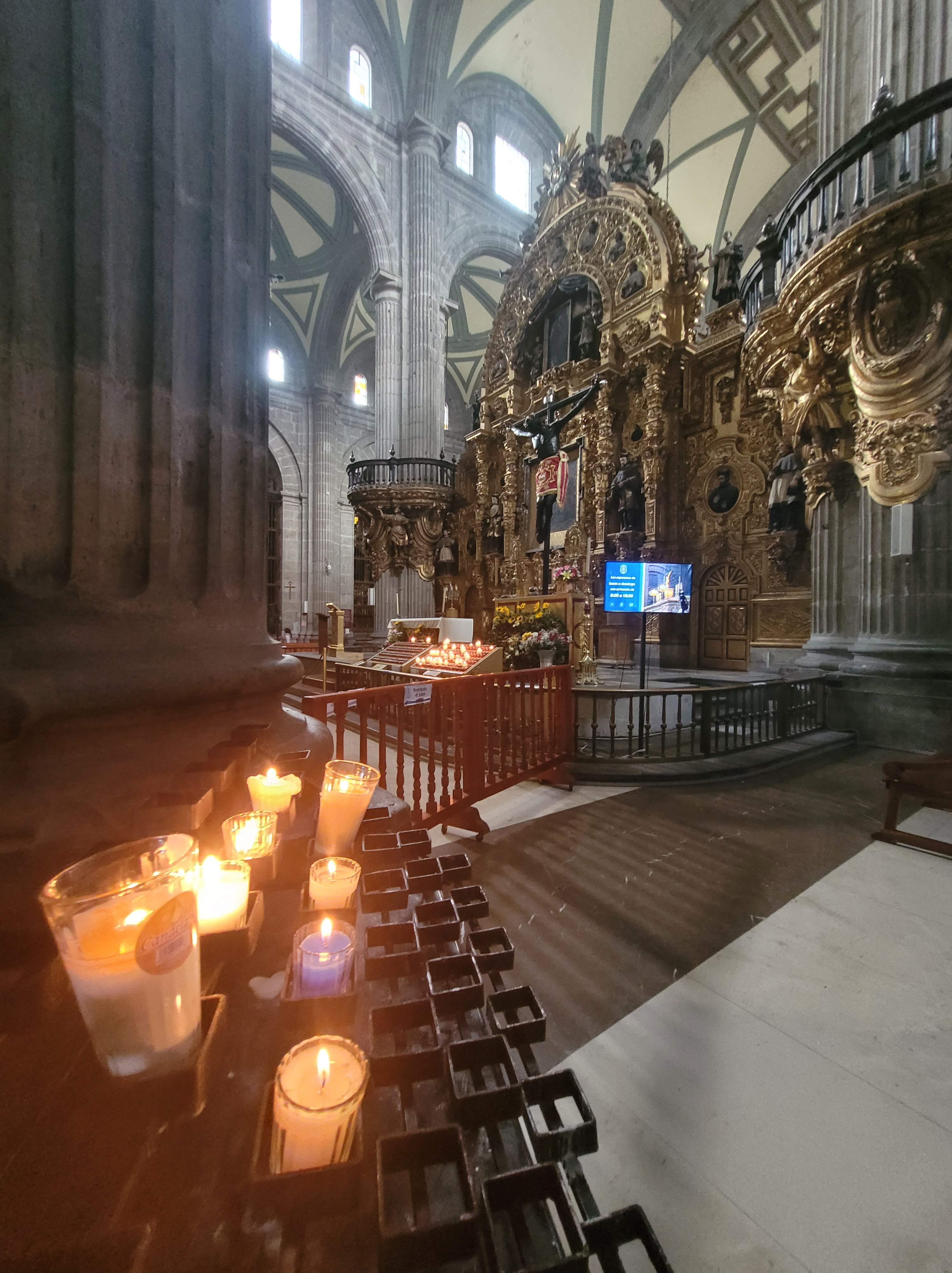
I remember being in a church in Shanghai, thinking that it must be the only place in the whole of that city where I understood what to do or what was going on. I happened upon a mass in Mexico – in Spanish, as masses in Mexico usually are – and knew precisely where in the liturgy the priest was, the prayers were identifiable by cadence and rhythm alone. I took shelter from searing Dehli heat in a cathedral, I met a man from Tipperary in a church in Kathmandu. I shed a tear at Handel’s Messiah in Des Moines, I saw jerseys of every county’s colour in Sydney.
My brain is wired when I’m travelling; I’m trying to see everything and do more, mind myself, suss out transit, appreciate places and notice their distinctions, respect them – all while not getting knocked down. And when I step across a church’s high sills and through mammoth mahogany doors, I leave behind city chaos and enter sacred calm.
At first, my eyes dart about, scanning and seeing. But I settle into my hard pew – back against a harder rail – and my mind winds down; it clears. And in the space created, there’s room to savour all I’ve been so lucky to see. And a chance to breath in deeply, to prepare for the next glorious bombardment.
Yes, tourists walk through with cameras that flash and voices that don’t lower. But most people in the seats are taking time from busyness; meditating in one form or another. I’ve been known to nod off once or twice, but usually I sit very still and go where my thoughts go. I marvel at the architecture and art. I grumble at enormity, often perched on top of poverty. But then I look around at the devoted – they’ve come for succour, they’re indifferent to gilded grandeur – and I remember that two things can be true at the one time.
That amongst the gaudy and godly rests the peace of many.
And it’s there – amongst the quietly faithful – I’ll think of my granny. My mass-going fell off after she died, and I think my younger piety must’ve been inspired by the serenity she found in faith. When I think of her, I see her in her navy high-back chair, rosary beads between her fingers, otherworldly in murmured petitions.
She used to send me up the church after Mass with coins to light candles. And here I am, all these years later, lighting them for her again. A twenty peso nod skyward, or remembering’s receipt maybe. And I smile every time, because I know full-well what she’d say to all the candles that e’er I lit, in every continent but one, ‘but Doireann, would you not just stay at home?’
But I don’t stay at home and she’s not here to ask, so the accidental crusade continues. I don’t know where we go after we die or who’s looking from where, or if there’s even a where. But when my little flame dances and I sit back a moment in my pew, there comes to me the most fleeting sensation of her presence. I can’t describe the sensation, nor would I try, it’s merely a moment of how it was when she was alive. I linger when it passes, but such sensations are fleeting as flaps of bees’ wings.
So I just sit a while, say a prayer or two – she’d like that. And when at last it’s time to go, I bless my face, and genuflect half-heartedly. Careful not to let the door thud, I step outside and take my place in chaos. To chase some train to another bus for the next museum in the other district.
Heart gladdened.
Revived again.
…for, though I’ve no idea
Church Going by Philip Larkin.
What this accoutred frowsty barn is worth,
It pleases me to stand in silence here;
A serious house on serious earth it is,
In whose blent air all our compulsions meet,
Are recognised, and robed as destinies.
Thanks for reading. If you enjoyed this, other posts can be found here – they’re mostly about Inis Meáin these days, but there’s stuff there about politics, home, rural living and other notions I took on given days. I’m on Twitter too, if you really like what you read!

 doireann.ie
Really enjoyed this beautiful piece Doireann ..
LikeLike
Thanks Doireann
I too am drawn to slipping in to a church for a quiet moment. I love the connections with your Granny! I believe she’s watchin’ over you as you travel. Look after yourself. Keep writing!
Slán go fóil
LikeLike
“two things can be true at the one time”
So true and often forgotten in conflict. A lovely piece. Great glorious barns providing peace for all races with or without religion.
LikeLike