
I’ve done a fair bit of moving around, I’ve lived in a good few places. I enjoyed my time in them all – made lifelong friends, learned more about the world – but never was I attached to them. Never did I think to myself, ‘here, maybe I’ll stay here’. Attachments were to people, not the places themselves.
I thought that never wanting to stay in one place was a failing on my part, a fecklessness of some sort or another. But when COVID hit, I spent more time in Roscommon than I had since the Leaving Cert. And then I moved to Inis Meáin. In one place the feeling of rootedness was palpable, in the other I found a different version of myself. I got attached to both places, deeply attached, in very different ways.
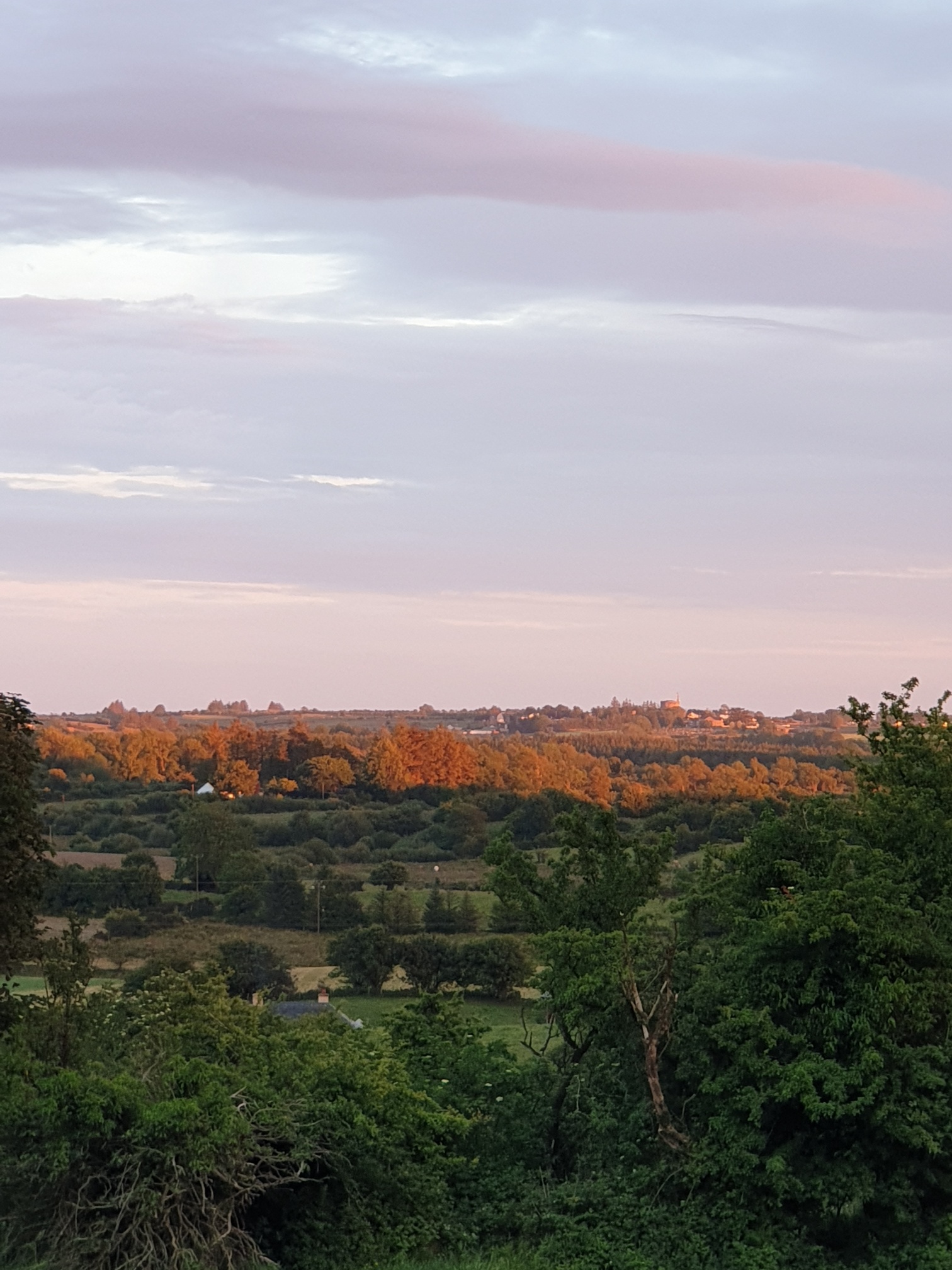
In west Roscommon, halfway up a hill, surrounded by great old trees, there is a house – a cottage, I suppose – with a front gate, and a concrete path running up to the front door. Nearly a century ago, this house started life as a kitchen with a room on either side, then time passed and bits were added. My grandparents lived there, and another generation before them. It is a quite unremarkable house and yet when I go there, a remarkable thing happens; I feel it in my heart, in my chest, that this is the place.
I feel it especially in the morning when, coffee in hand, toes cold in slippers, I stand at the front door and savour the view. All land is there for miles; green fields, dark forestry, brown bogs. Directly across from this door, two maybe three miles away, is the churchyard where my grandfather’s people are buried. They all lived in this house ó ghlúin go glúin. Indeed, in more recent times, most of us have done a stint living in it.
I feel a rootedness in the ground that surrounds the house. It is full of story. Out front, though the planters are long gone, the daffodils they sowed return doggedly every year. In back fields, there are piles of rocks, picked by hand to reclaim the land. Those pickers are long gone – they emigrated, they died, they went away – but they live on in the names by which we still call those fields; Heneghans, Cravens, Marys.
Inside in the house, the living room has a fireplace as tall as me, and the stove there is fuelled by the same bank of turf that has always heated the house. When the fire is going, and I am by it in an old armchair, words and ideas flow.
And I think to myself, ‘island? What island?
Ah, the island. Quite a lovely island it is. Lovely enough to summon a broad smile at first glimpse from the bridge at Furbo. Lovely enough that I am startled by some splendid beauty every single day. Something of me has been unlocked here, some unknown ingredient that brought out the better of me.
When I think of the future, of leaving here, I think of what I’d be leaving. To some degree or another, I’d be leaving the language, and that which comes alive in its lyricism. My Irish leaves much to be desired, but the joy of learning language lies in the slow reveal of another dimension with which all of life can be viewed.
I’d be leaving the security of the small society and the life I have loved here. The friendships, the ways, the serenity, the consensus that there is more to the world than just what we see and touch. The creed of landscape, moon, tide and wind.
When I think of leaving, I think first and last of leaving the sea. Because when the thought of leaving the sea occurs to me, I shut it down and think of something else. How could I be away from Atlantic infinitude, out of sight of the horizon, away from the smell of the sea and salt in the air? Away from the swim, the daily baptism in this mighty landscape? No, sure I couldn’t live in the confines of an inland county, I couldn’t listen to the silence of tideless environs.
And I think to myself, ‘cottage? What cottage?’
I thought this was a bad thing, that being neither here nor there meant I was nowhere. That I should be settled by now in a place, one place. That I’m too long in the tooth not to have walls of my own on which to hang all I’ve never framed, too long at it to not own Christmas decorations because they too would need packing. I’m regularly envious of people with nice desks or bookshelves, sore that they’re settled enough to have heavy, fitted fixtures. Rarely am I as quick to recall that I could’ve settled somewhere if I’d wanted to, that the novelty of built-in bookshelves might wear off, that I made my own choices, that the regrets I have are too few to mention…
Instead of one place, I have found two. Most of those settled people with their heavy desks and built-in bookshelves also have more than one place but they prioritised children, careers, leisure, natural beauty and innumerable other factors over the place they dreamed of, over their idea of a rooted spot. And they were happy to do so. On the other hand, many migrants never again get to see or visit the places they’re attached to. Some people don’t care. For many, ‘the place’ fades and makes way for where they now find themselves.
It may well be the same for me.
I’d hate to leave the sea but over the Christmas in decidedly sea-less Roscommon, I never thought of it once. I’m on the island now, dreaming not of a high fireplace or a door open to the morning, but gazing out at the Twelve Bens, thundering waves and the Loop Head lighthouse.
That contentment could be found by just being in a beloved place was news to me, but I suspect many reading this will wonder at my wonder, having themselves cottoned on long ago that contentment lies not in the tie to one place, but in the appreciation of several. And that some of those places are real, some are imagined, some are seen every day and others never to be visited again. That attachments are as different as their places, and none the less worthy for that.
Who knows, there could be settling in me yet.
Note: Some of this is borrowed from a piece I wrote before on a similar-ish theme called ‘It Takes a Village’ which I took down to enter into a competition (I didn’t win). I couldn’t find the piece to repost it, so I used bits I remembered here instead.
Thanks for reading. If you enjoyed this, other posts can be found here – they’re mostly about Inis Meáin these days, but there’s stuff there about politics, home, rural living and other notions I took on given days. I’m on Twitter too, if you really like what you read!!

 doireann.ie
Great piece Doireann, lovely. I get it like a mirror…East Mayo village home…Inis Meain Island home.
LikeLike
Hi Doireann, happy new year. Reading that..God, I could write the exact same piece, just change the names of the fields (and the home fireplace is a small one). East Mayo, Carracastle, Christmas, no thought of the sea, the other life, no babbling in that strange lingo. The sea will be there. Not sure of any solution, but.I built the house after renting forever…finally at about 46yo (not in the home village of Carracastle but on the estuary near Killala)….all the heavy fixed furniture, architectural minimalism, big trees, river in my front yard…..everyone wows and oohs when they (extremely few) visit. I will walk away from this soon….heavy furniture left behind, even a vinny height fireplace in cool concrete with hand carved elm pilasters…once I sell it, without even a look in the rear view mirror….not sure why… I think we are just lucky though, to have both the home place and the island..its like two dimensions with no link between either place. V
On Sun, Jan 9, 2022 at 9:49 PM Doireann in America wrote:
> doireanninamerica posted: ” I’ve done a fair bit of moving around, I’ve > lived in a good few places. I enjoyed my time in them all – made lifelong > friends, learned more about the world – but never was I attached to them. > Never did I think to myself, ‘here, maybe I’ll stay here’. Att” >
LikeLike
Another lovely lovely read Doireann, thanks so much. It really put me thinking too that we say we are going home to Fiddown and when we are leaving we say we are going home to Inis Meáin. It reminds me of a song a cousin of mine Robbie O Connell wrote and sings. It’s called Hard to say Goodbye. It talks of liking to be in two places at one time. Lovely writing love reading your pieces. GRMA
LikeLike