
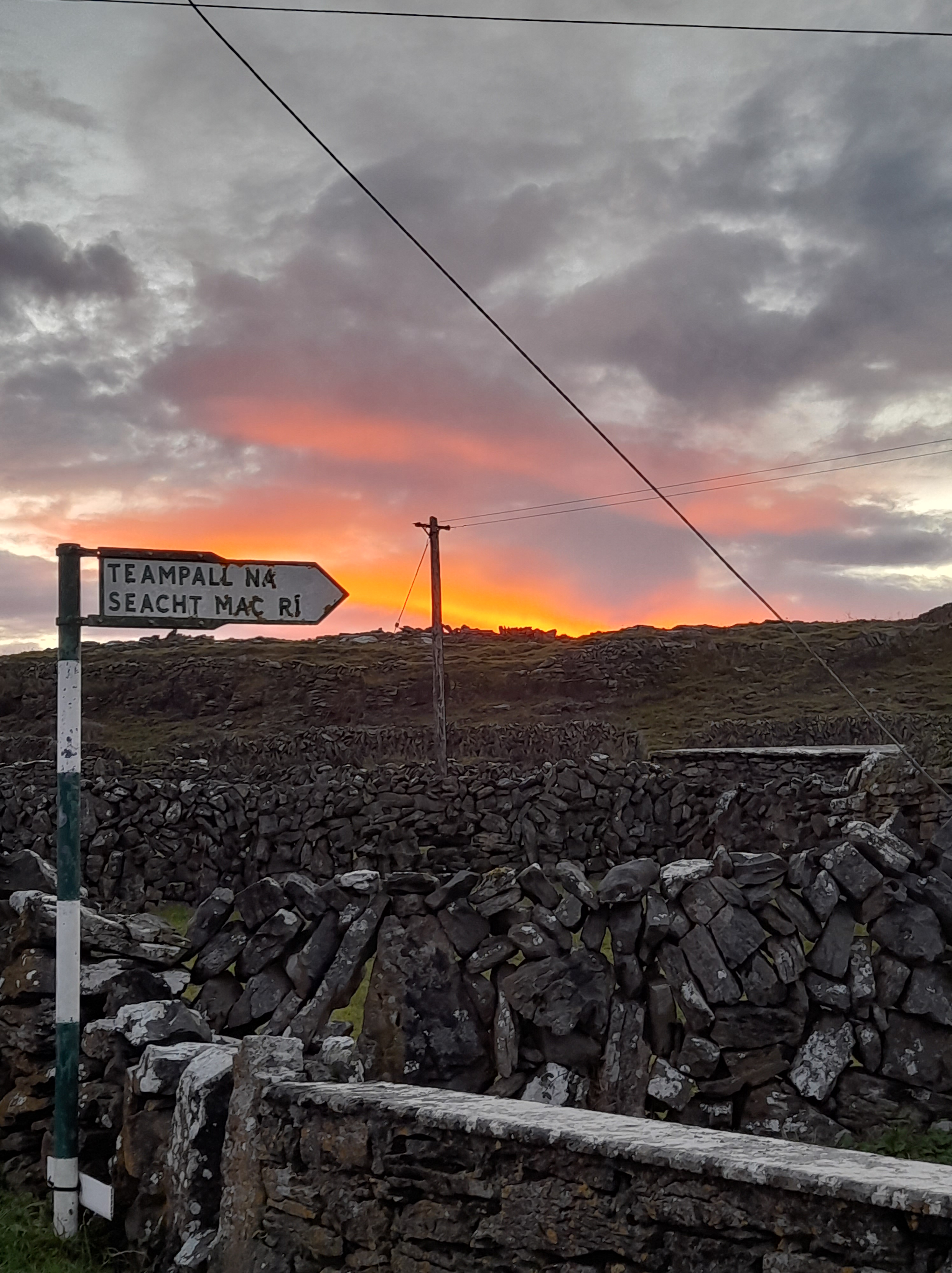
(If anyone knows how to make those cover images smaller, can they please let me know!)
I really like Irish. I hadn’t much heed on it in school and scraped into St. Pats on the minimal mark they let people in with, but summers in Eachléim had given me a grá for speaking Irish and somewhere between school and here, I fell in love with the language.
I also love islands, so moving to a Gaeltacht island has been a solid life choice.
There are many joys to my life on the island – the scenery, the unfussiness of it all, my job, the sea – but perhaps my greatest joy is hearing Irish spoken and used every day. There are challenges in developing and bettering my Irish, but they’re small potatoes compared to the honour of being where the language lives.
I am on the backfoot speaking Irish. Though an online test tells me I am an Advanced Learner, I don’t feel particularly ‘advanced’ when I’m mid-sentence and realise I don’t know how to finish it. There’s nothing ‘advanced’ either about the quip that zings in English, but flops in Irish. My brain is on fire from trying to carry on conversations while furiously scrolling my lexicon, switching around words and rephrasing, scrambling for a different way of conveying what I’m trying to say, resisting the temptation just to say the damned thing in English.
The temptation is say the damned thing in English is never not there.
But on the other hand, I’m always learning. The most offhand comment over lunch or out walking will ping a lightbulb in my brain – ah! That’s how you say that! Or even better, when I hear a better version of what I was saying – one more elegant, more lyrical, more poetic.
I record any new words or phrases on the phone and WhatsApp them to myself to write in the notebook later. I stick to watching TG4 so that even when flopped in front of the tele, I’m learning. Every episode of Ros na Rún is explosive when you only understood half of it, and miss all of the subtleties of the dialogue. I’ve gotten the complete wrong end of the stick from a few stories on the Radió na Gaeltachta news, but that’s happening less and less now.
Developing my Irish takes bit of resilience too – or brazening it out – because nothing makes me more self-conscious than what’s coming out of my mouth (she said, in her blog). Children tend to pick up languages quicker because they’re less self-conscious about making mistakes.
Most of the time I’m grand, and most people I chat with freely (and am happy when my mistakes are corrected) but there are also situations where I get nervous and trip over the simplest of phrases, where I speak too fast to cover up the mistakes I know I’m going to make. Though I know I’d scarcely register the mistakes of someone learning English, it’s in the back of my mind that people will think me a fool if I make a similar mistake as Gaeilge no matter how often the rational part of me tells me they won’t.
A bit much? Tell me about it. But it’s not just me. Anyone interested in Irish has the cúpla focal but most hesitate to use it for fear of being thought a fool if they can’t keep up. They panic and just use English. English just always feels handier, and that’s unfortunate.
Fortunately, we are all far simpler creatures than we care to admit. We use the same words every day, we’re constantly drawing from the same small, well-worn banks. So it’s not a language that needs to be mastered, but our own banks of words. Master them and confidence will follow. With confidence comes comfort and ease.


A remarkable thing about learning and developing Irish on Inis Meáin is witnessing the language lived. Lived as a first language, as the language of transaction, of children in a schoolyard and men leaning on gates. Lived, not as performance or the proving of a point, but as the dominant language, the one best understood by those raised here.
Watching the language living and breathing has taught me much.
Firstly, Irish is the first language of muintir na gaeltachta just as English is mine. When native speakers want services be provided through Irish, it’s not to prove a point; it’s because they best understand official documents in their own language, just as I understand them better in English. Why shouldn’t native speakers have access to Irish-speaking Gardaí? I was mithered by Ventry being signposted as Cionn Trá in Kerry, never mind navigating public services or filling in forms in a second language. Speakers of a country’s native tongue shouldn’t have to do that.
Secondly, there isn’t an English for everything. Wondering what a surname or placename is in English is as irrelevant on the island as wondering what Markham is in German. Translators have colossal qualifications because languages don’t perfectly translate; their words and phrases are matched as closely as possible. Literal translations rarely land.
Thirdly, the variations of Irish within miles is astonishing. Teachers’ handbooks come in four dialects – Connaught, Munster, Ulster and standard – and even in the Connacht versions, my predecessors have crossed out words and replaced them with what’s used in these parts. Inis Meáin has its own unique turns on the language; a flower here is a pabhsaer, a potatoe is a fata, and the weather deserves its own dictionary. I’m always touched when older people make a point of highlighting and teaching me a local word, entrusting it to me, like pressing a pound coin into my palm.
Language is everywhere and though I might be exhausted by it, and though I’ll never truly master its richness and beauty, my love of the language has only grown. I’m hungry for it, always looking for more, and am extraordinarily privileged that I’m learning it from the best – from the masters themselves. I just hope I don’t wear out their patience.
There’s more where that came from, click on the homepage for posts on living in America, island life, rural lockdown, musings on history and current affairs, and schlepping through the United States
Or follow me on Twitter, sure I’m great craic.

 doireann.ie