

The Lonely Planet says of Inis Meáin’s islanders that they are unconcerned with the prospect of attracting the tourist dollar and, as a result, facilities are scarce. But like the other islands of which the same could be said, it is that modesty and naturalness that is Inis Meáin’s primary draw. The island is at once bleak and alluring, as much a reminder of how handy we have it here and how unnecessary much of what we have is. I spent the weekend there and will return for many more, for where better place to go to improve my Irish than the island Synge, Hyde, Lady Gregory and Pearse went to develop theirs?


In Chicago, like the good Irish citizen, I sold the beauty of Ireland to anyone foolish enough to get me started on it, and capped the spiel with the insider’s tip; the west’s offshore islands are where Americans will find the Ireland they’re looking for. Generations of writers, academics, poets and rebels have come to the islands for creative inspiration for well over a century. The Ireland they dreamed of – frugal, Gaelic and ‘home of a people who valued material wealth only as a basis for right living’ – they found on the islands, and much of that is to be found there today.
But successive governments of the subsequent nation consistently neglected the islanders, portraying island lives as idyllic but doing little to sustain or support that supposed ideal. The islands are not museums for our entertainment – it doesn’t take a census to tell us they are haemorrhaging young people – but vibrant communities that need support to survive. They go without a lot of the conveniences we scarcely consider and if we are serious about preserving their way of life, we must put our money where our mouths are.
Ireland’s offshore islands are wonderful places to visit, spend time in and develop our Irish. To visit them is to be ‘away’ at home, turning Ireland as we know it on its head. I remember a few years ago on Donegal’s Arranmore trying to explain to my niece that despite getting a boat there, we were still in Donegal and Ireland. Likewise, on Inis Meáin, as we looked across at Galway and the west coast of Clare, it was Ireland before us – but from a wildly different perspective, both geographically and socially.
Inis Meáin lies some thirty miles off the coast of Ireland and is roughly 3km x 5km with a population of 183 by the 2016 census’ count. Irish is the spoken language of the island. There’s a primary school, a secondary school, a shop with the post office, a library, the exclusive Inis Meáin Restaurant and Suites and the Inis Meáin Knitting Company. In the trio of the Aran Islands, it lies between Inis Mór and Inis Oírr and is accessed by boat from Ros a’ Mhíl or small plane from Inverin. From the island, the Cliffs of Moher can be seen to the east and the southern Connemara coast to the north.
The houses and the village part of the island slope upwards, well back from the shore and overlooking a network of small fields, all meticulously enclosed by limestone ditches.
The island is home to Inis Meáin Knitting Co., a global knitting brand, that supplies unique, high-quality knitwear around the world to places as far flung as Seoul, Zurich, New York (Bloomingdales!) and Vancouver.
It’s a cliché but there’s no need for phones really; there’s no need for Google Maps because the most general sense of cardinal directions will get you back to the house, tell the landlady what time you’ll be back, she’ll tell the taximan to call for you if you’re getting the boat. That’s a luxury in a world that’s too damned demanding sometimes.
It is a joy to hear Irish spoken, and even more of a joy – when I plucked up the courage – to use it in the shop and the pub. I don’t find it difficult to understand and hearing it spoken somewhere other than Dublin motivated me to get working on my own Irish (oh silly Irish universities, did you think you were rid of me??)

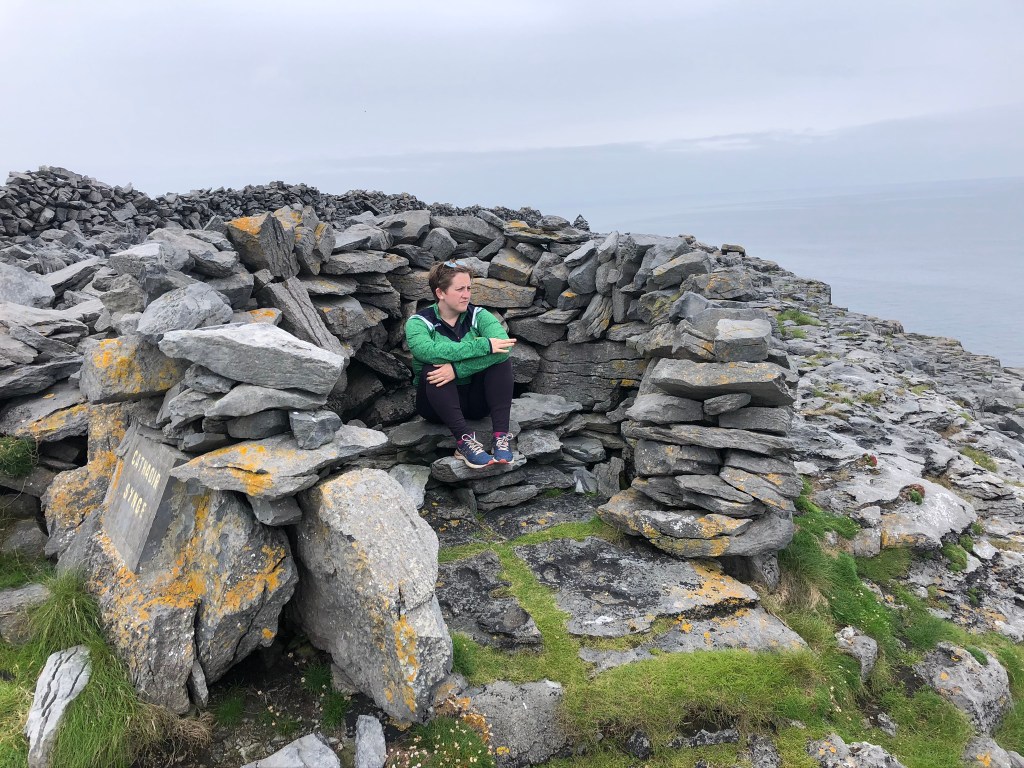

Inis Meáin is a wild place but draws people today from city lives and English-speaking urbania via the factory, the schools, the gaelcholáiste and its way of life. It was here that Synge got the inspiration for Playboy of the Western World and Riders to the Sea, and hidden on a remote part of the island is Synge’s Chair, a viewpoint with a beehive-shaped enclosure of rocks. It’d be tempting to think of Synge’s chair as a gimmick, but even on a dull-ish day, we sat for a long time lost in our thoughts and ideas and could well see where inspiration is found here.
There’s something attractive about a place where not a lot of money can be spent, where only that needed warrants getting. Life there I imagine is often not easy but I can see how generations before me fell into the trap of idealising the modesty of island life.
From where I write, we were never short of stones and rocks but we’ve the plains of Kildare here in comparison to Inis Meáin. On Inis Meáin there are fields that are plains of limestone, with little or no grass, just beds of rock covering the whole of the field, neatly enclosed by stone ditches. The ditches consist of flat rock standing upright in row on row, too slim to stack. There is green too; fields too where the low intensity farming practised allows wildflowers pop colour and biodiversity flourishes.
The knitting factory and its shop provide unexpected glamour to the island. We’re not talking Liam Clancy aran jumpers here but variations on the traditional styles that make now for a luxury global knitwear brand. Or, as Esquire magazine headlined an article on the company, ‘Inside (Probably) The Most Remote Luxury Brand In The World’[1]
Life isn’t ideal on Inis Meáin and everyday work goes into keeping the island alive and vibrant. There are of course advantages to life there; in a world where everything has a price and a souvenir mug, on Inis Meáin there is largely only what is needed and we could learn from that. So too could we learn from the independence of the islanders, who entrust themselves to each other for survival. It is a world apart for the visitor, a place where time is in abundance and rushing isn’t really a thing.
Should I ever return to America, my spiel will remain the same; head west, and then head further west.
Follow me on Twitter, I’m great craic. Or put the kettle on and click on the homepage to browse nearly fifty other posts.
[1] Esquire, 9 January 2020.

 doireann.ie
The island is a strange place. Especially when you live there for any extended period of time.
LikeLike
Absolutely. There are times I need reminding to see it, but it’s never less than remarkable
LikeLike