
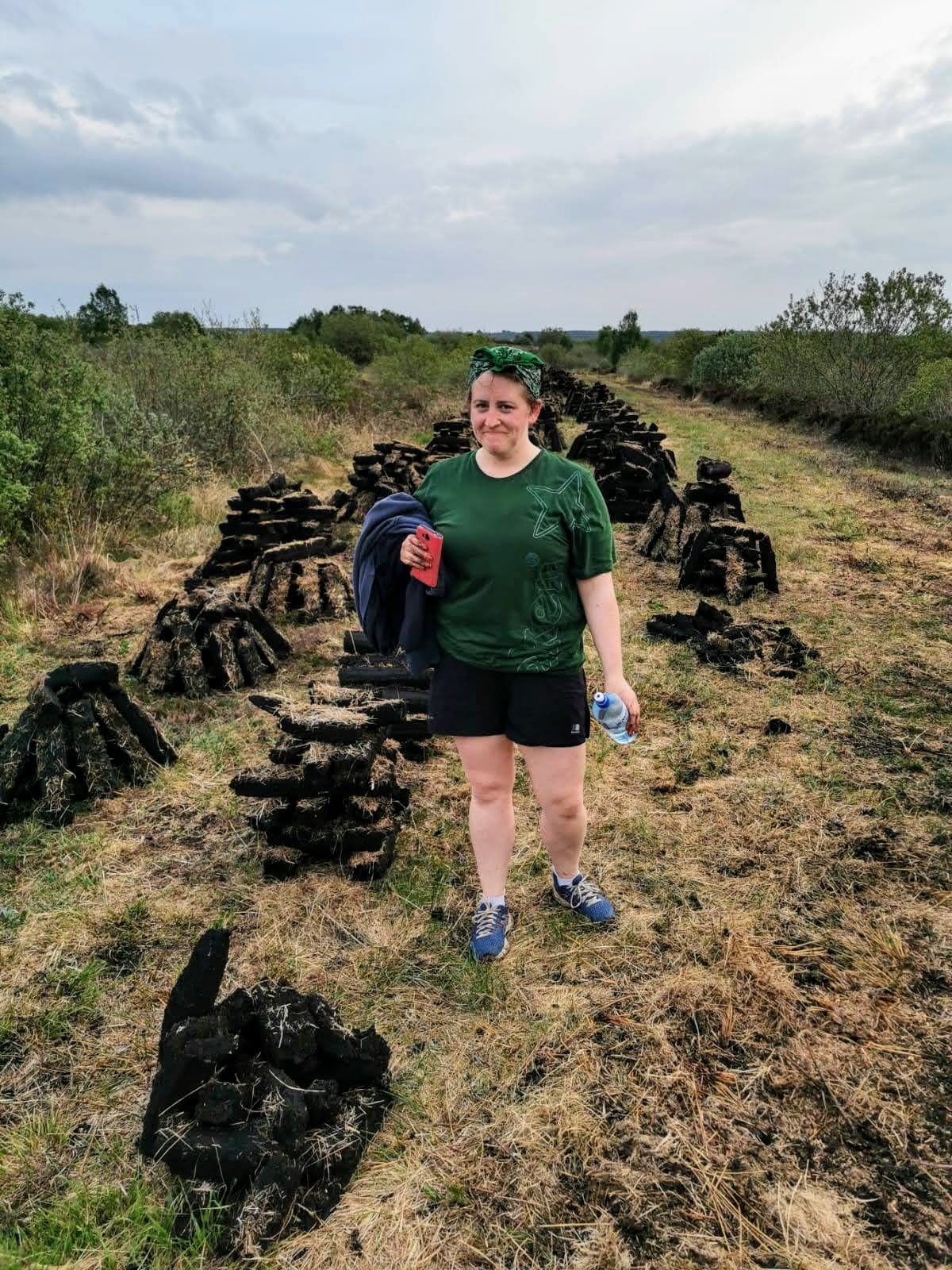
I went to the bog.
You might know I went to the bog because I posted a picture of me in the bog. The bog’s rarest callers are its most prolific selfie-takers.
The bog has a special position in the Irish imagination; an otherworldly place that we avoid like the plague as children but Instagram the living daylights out of in adulthood. Saving turf is an experience that connects most rural Irish childhoods. It is an experience also that binds us to those who’ve gone before, for their methods differ little from ours today.
Though nostalgia dictates that we should preserve such a cultural tradition, nostalgia must be balanced with reality and our duty to protect what we have for those coming behind us.
As with land, we’re merely caretakers passing through. The bogs date back to the aftermath of the Ice Age. We date back to a minute ago, in comparison.
My family saves turf in a bog that sits near the apex of the train line and the lake. The bog is known as the Mountain Bog, though there isn’t a mountain for fifty miles. The bog is vast flatland – by no means endless – but to pause there for a moment is to stand in the heart of stillness. The bog is wild; houses feel faraway, it’s silent but for birdsong and wildlife, and the only sign of modern life is the parked car of another labourer (well that and sneaky headphones; the bog’s beautiful but the work’s pretty monotonous).
But I digress.
I don’t know the names or species of the bog’s plants and animals, but I know the bog’s colours; strips of yellowed spartan grass flattened like a combover, bog hole walls so intensely brown they might be black, occasional green grass lost in its barren brown surrounds, heather clumps of mint green and purple. Turf’s brown faintly grays as it dries and hardens. Creamy white bog cotton, hardier than they look, toss their flighty heads in the wind.
We cut where our grandparents cut, in much the same way they did. Machines replaced sleans (thank God) and horse or donkey-drawn trailers, but otherwise we turn it, foot (stack) it, load it and unload it much as they did – albeit with hands much softer than theirs.
I hated the bog as a child and may have been the first person in my family whose insufferable whinging excused them from a duty. The heads of the household could not be seen to yield to such tactics so a détente was reached when I announced I couldn’t go to the bog because I had to mind Granny. Granny was more than capable of minding herself but played along, having nursed a similar attitude to the bog herself for many years.
But turf-cutting is a fading tradition as newly-built houses can’t be heated by solid fuel (the smoke from turf does more harm to the air than coal) and fewer families are choosing to labour over turf. Despite this modern reality, our bogs are a hugely important part of our national heritage.
Our grandparents and ancestors toiled on this very ground, and we sink our hands into the same wet organic matter they did. Turbary rights – the right to cut and carry away turf from a specific plot of bog land – dictated who was permitted to cut what and where. We cut turf on banks passed down to us through generations, bearing names of households long dead and gone. The banks of my family were cut by my great-grandparents a century ago.
The story of Connacht is in the bogs. Much of Cromwell’s disregard for Connacht was borne of the prevalence of barren bog land. Bog land, to put it mildly, is unsuited to pasture and Connacht was the least grassed province of the country.
Humans need food, fuel and water to survive. The bogs gave our forefathers fuel but, useless for agriculture, they robbed generations of the sustenance and livelihoods grazing land might have provided. The bleakest of Famine imagery shows starving families, close to death, huddled around a fire.
The bogs preserved our histories for us. The chalices and gold, the bodies and butter preserved by the bogs’ moisture – and stored now in the National Museum – connect us to lives lead millennia ago.
It is little wonder the bogs have captivated poets, painters and artists.
The cutting of turf on bogs won’t go on forever. The raised bogs of Ireland are the finest example of their type in Europe, and probably the world, and are increasingly seen as special places to be preserved and minded before they disappear altogether. Bog walks are increasingly common and hugely popular, the serenity and wildness they offer being almost unique in otherwise bustling worlds.
Despite the refuge they offer from the world, the bogs are among the most contested spaces in rural Ireland. Previous ham-fisted efforts by governments to limit turf-cutting set rural Ireland on a collision course with international efforts to tackle climate change. Environmentalists point to the importance of retaining the bogs as carbon sinks (natural reservoirs for carbon that lower the concentration of CO2 from the atmosphere) and refuges for wildlife. The turf cutters and many rural activists point to the cultural tradition of cutting and saving turf, and see threats to that tradition as further assault on the interests of rural Ireland. Neither side heeded the concerns of the other to any great extent.
Tradition is important, but not infallible. If the tradition causes harm, that harm cannot merely be ignored.
For my part, now that I’ve volunteered once, there’ll be no getting out of going to the bog again. What’s turned needs footing, what’s footed needs bagging, throwing on a reek or on to a trailer. I’ll need to charge up the headphones. Nonetheless, I adore the local bog walk and I’m such a fan of the development of walking trails and looped walks around bogs, education programmes, talks and workshops. My only gripe is that our grandchildren will get to explore, examine, smell and spy the bogs for many years to come… without ever having to foot a feckin’ sod of turf in their lives.

 doireann.ie