I had to fact check something on the 1901 and 1911 censuses for last week’s piece and with time on my hands, I dug a little deeper than other times when I’d be messing about, just looking for people related to me. This time, I’d an eye out for patterns, trends and quirks; road signs that pointed to how people lived. And I got the briefest glimpse into life back then. Like us today, the people then were in a period of social upheaval they didn’t fully understand. As with today, their lives were heavily influenced by political, social and economic forces they knew very little about. Like today, the poor of back then were blamed for their own poverty. The next census is due in April 2026 which means that in 106 years time, our descendants will be looking at our society in bemusement and wonder, with a better view than we have of the forces that shape our lives.
The census returns give us a heap of information on what life was like back in 1901 and 1911, and it’s not life in farflung places but life in our own towns and villages. Here’s a bit of what I noticed.
Most women around here married in their thirties, and were married to men ten years older; men who’d had to wait for parents to die before land could be inherited and dowries paid. Women had children in their thirties and forties, and many late into their forties.
Now, on saying that, people may or may not have known their exact age. A respondent who was 26 in 1901 might be 39 in 1911, but a year or two was often added for good measure for fear it might be used in later pension applications. Children’s ages were remembered though.
In a country where child mortality was 81 children per 1000 dying, the vast majority of children born around here survived childhood. The CSO’s analysis backs this up; Dublin had the highest rate of infant mortality – i.e. children dying – and Roscommon the lowest in 1911. The inclusion of a ‘total children born living’ and ‘children still living’ question was presumably included to gather data and tackle infant mortality. Questions don’t get included on censuses for the craic.
Just one person in a village of 127 made it to 80 in 1901. 4 lived to their eighties in 1911; the oldest was 88. More power to her, she was in her twenties when blight turned the potatoes black.
Some names survive, others on the 1901 census were no more in 1911. The pool of names was small, and forenames passed on so often that to figure out who is kin today is to seek a headache.
It was different in town, but in the countryside young men were farmers’ sons and women were farmers’ daughters, without exception. Comparison of the village in 1901 and 1911 shows a net loss of ten people. The poverty wasn’t like other areas where kids were away at 15, but every person between 11 and 25 in 1901 was gone by 1911. So present is emigration in this country’s history, we forget that a country that reared children to put them on boats was not a properly functioning state.
We view the past with a widescreen, panoramic lens, but live our lives in the microscopic. We are sympathetic to the people of 1901 and 1911 because we see them as part of a wider picture. The ‘bigger picture’ back then was the Land Acts, British imperialism and careless governance when Ireland haemorrhaged young people more than any other European country and impoverished tenants toiled for gilded landlords (we call that inequality today).
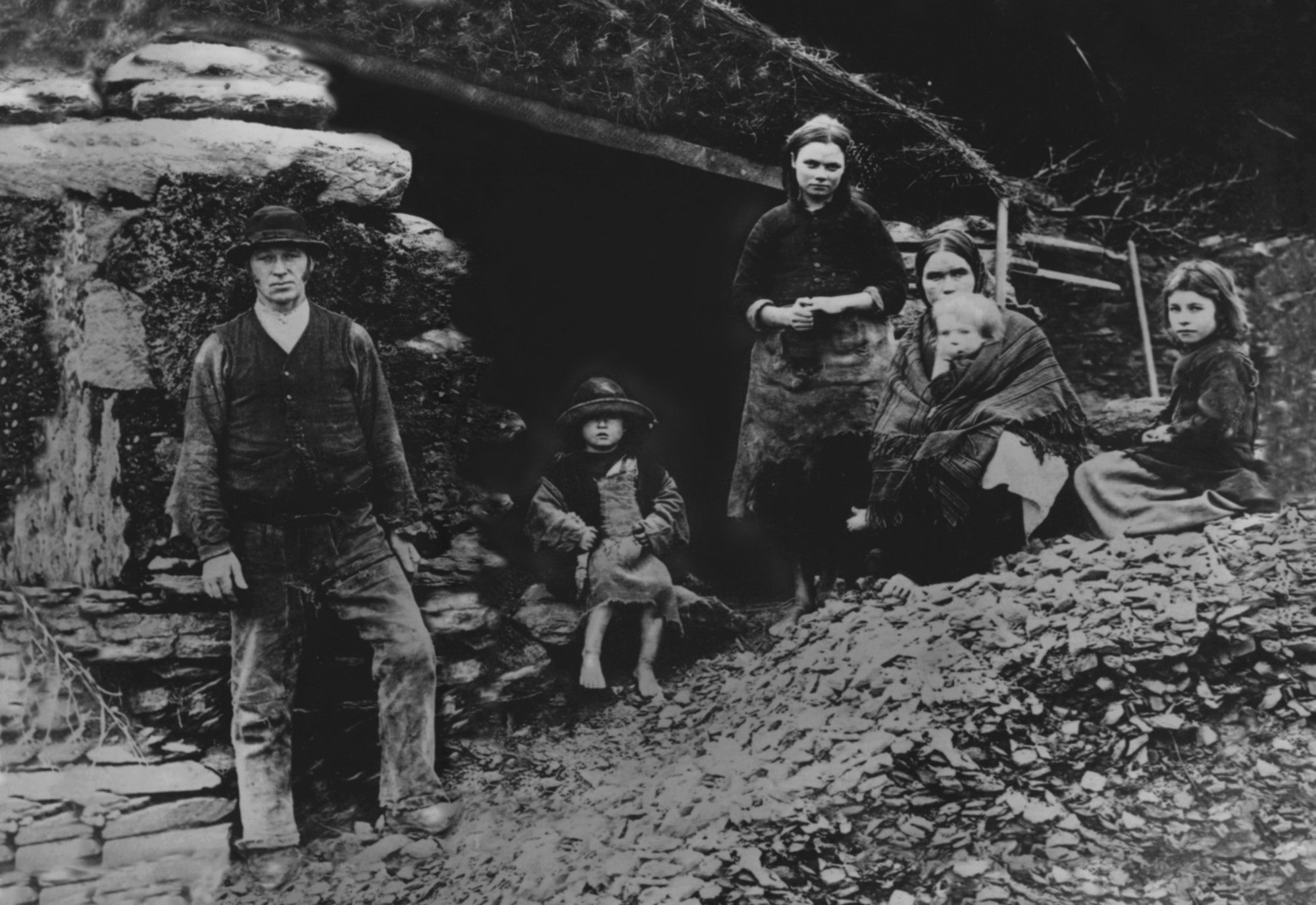
We wouldn’t dream of looking at the household of nine, living in a two-room house with perishable roof, and blaming them for their poverty.
Nobody looking at the 2021 census results in a century’s time (censuses are held under lock and key for a hundred years) is going to pinpoint a family or a person or a village and say, “well it was their own fault really, wasn’t it?” They’ll see that our lives were unwittingly influenced by galloping consumerism, political polarisation and cultish individualism.
So why do we blame today’s poor for their own poverty?
It’s a bit Victorian of us really.
The Victorians believed the Irish were responsible for their own poverty (most notably the Famine, widely seen in Britain as God’s punishment of the Irish for their feckless ways), that the Irish got nothing less than they deserved. That explanation was pretty convenient for the Victorians because it let the people with actual power off the hook. Blaming others for their own poverty has been – and still is – a most easy pastime for the comfortable.
Personal responsibility is important but as our own history teaches us, there’s only so much we can control by making all the right decisions all the time.
But the wheels keep turning. They were turning in 1901 and 1911, when the real Irish revolution was happening, the one people that changed people’s lives. The Land Acts allowed tenants buy the land they had farmed for generations, to live more securely and worry less about starvation. Independence made little real impact on people’s lives, other than making them poorer.
We’ve lived through our own revolution. The internet changed our lives, our society, our habits and how we interact. We’re used of it now. In 1901, small farmers dreamed of owning their own land. By 1911, people were pretty used of it.
But more social upheaval awaited.
In 1911, the Great War – the war to end all wars – was just three years away. Partition of Ireland was nine years away, and independence ten. People who had been evicted from mud huts would see the Union Jack lowered to be replaced with a tricolour, the realizing of a centuries-old dream. They would spend years rebuilding the country after the ravages of two wars, one of independence and the other fought over the nature of that very independence. Afterward they’d watch more of their children emigrate, for Ireland in the 1920s and 1930s was poorer than ever it would have been under British rule.
Wheels keep turning, but how they turn doesn’t change. A wheel in 1911 went around and round and round, just as it does in 2020. They were on a cusp. We are on a cusp. Our experiences are not unique to this one moment.
So now, there you go. No use weeping at Strumpet City if you’re giving out about Tesco workers striking today. That’s only one conclusion I came up with after browsing the census, but you’ll come up with your own. Be warned; the 1901 and 1911 censuses are mines of information but they draw you down more rabbit holes than YouTube’s algorithm does. You’ll start looking for a great grandparent and four hours later, you’re counting Protestants on Inisboffin. But time learning is never time wasted and in this fast-paced world, isn’t it a relief to know that the good people of 1901 and 1911 still have plenty to teach us about ourselves.
Re. the Doireanns in the country – and you better believe I checked to see how many there were – there were none in 1901. In 1911, there was one Doireann and she was in a college in Belfast training to be a primary school teacher….. because even in 1911, you couldn’t beat the oul’ teaching.

 doireann.ie