
Last Thursday, 4 July, was Independence Day; the 243rd birthday of the United States. Though Independence Day celebrations take various forms, there’s little doubt that national mythology and sloganeering are a central tenet of the day’s fare; basically, America is the ‘Land of the Free and the Home of the Brave’ and that’s it, no time for questions, thanks for coming, safe home, bye. Every country promotes myths and stories about its own heroic past. Historians dismantle the myths and to be fair, they’re sound enough to do it in obscure academic journals, thus letting us keep telling ourselves that the Irish built America and St. Patrick got rid of the snakes. But though the myths and stories might be ridiculous sometimes (sorry, Oisín was what age when he got back to Ireland??) they’re important in uniting citizens and feeding the national pride that nourishes the nation. I didn’t buy into the whole sea-to-shining-sea business on Thursday but I was more than happy to participate and be swept up in it. Like a big Yank.
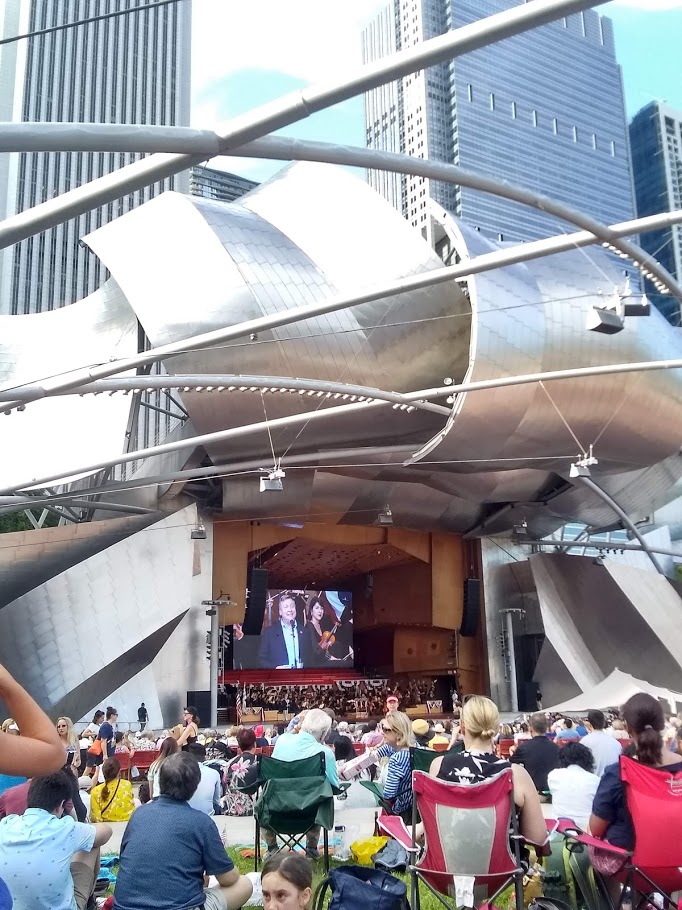


Left to right: Pritzker Pavillion at Grant Park and the Grant Park orchestra, subtle messaging there on a downtown building, my wee flag, yours truly and the wee flag (the tin of wine was unavailable for pictures at that time)
Independence Day is basically a community celebration. Ideally, for the promotion of national pride, the ‘community’ in question would be the entire nation but that’s 327 million people and that would make for quite the unruly barbeque. Nonetheless, for many it’s catching up with mates and in Rogers Park, it was definitely a day for family and local community. The beach and park were alive with cookouts, gazebos, beers, music and games of football. I went to the Independence Day Salute Concert downtown where the Grant Park Orchestra marked the day with a selection of classical American pieces (and Tchaikovsky’s 1812 overture which… isn’t American. At all. Like, not even a little bit. But it had cannons!). The concert was stunning; I love watching music being made and I recognised most of the pieces as I sipped on my can of wine (yeah…) and delighted in the joys of a full orchestra in a park of a summer’s evening. The Navy Pier fireworks are the highlight of Chicago’s Independence Day program so when darkness fell, I found myself a nice perch, lay back and watched the colours burst through the night sky.
The day’s highlight undoubtedly was the concert and the music that united my head and heart in joy, which was no accident of art. That wily lot at Grant Park knew exactly what they were doing with their rousing selection of marches and patriotic music. Nostalgia and emotion were flicked on like light switches with instantly recognisable American classics. Patriotism was fired up with the official songs of all branches of the military and the veterans being invited to stand for applause when their song was played. The mini flags we had gotten did whatever flags are supposed to do. If you didn’t shed a tear in the first half, they had the equivalent of My Sisters Keeper at the ready after the intermission; Shenandoah and a medley of various songs like Tenneessee Waltz, Deep in the Heart of Texas, New York New York etc., doubling down on the nostalgia by making it local/personal. Behind the orchestra was a screen that showed sweeping shots of the prairies, the national parks, the Grand Canyon, the Mississippi River and countless other natural wonders to reinforce the idea that America’s greatness is natural or God-given. Throw a few shots of US soldiers out-foreign or single flags fluttering in the wind and we hadn’t a hope; we were all swept away by it, powerless in its emotional torrent, with some members of the audience googling train tickets to prairies and whether or not Legends of the Fall is on Netflix (me, and it is).
But though I speak lightly of it, I’m jealous of Americans having their day of national pride, silly eagle-embossed t-shirts and the downtown office building lit up to read ‘Land of Liberty’. Every nation needs at least some myths to unite and foster a shared past. And such myths are fine to go along with, so long as they don’t cause harm (as for example, Ireland’s story of its Catholic self did in the past, causing untold trauma to many). When the 2023 World Cup bid was launched, we oohed and aahed in pride at shots of the Skelligs and Liam Neeson telling us for as long as anyone can remember we’ve been a plucky wee lot, out there on the edge of Europe! Sure don’t we know it Liam, aren’t we the island of Saint and Scholars, the ones who brought the British Empire to its knees and isn’t hurling older than the Stone Age?! Such slogans and myths don’t stand up to much scrutiny, but they’re still important because they serve as ideals we can aspire to, or ambiguities we can gather around. Outside of sport, that’s increasingly rare, owing to a greater concentration on individual rather than community aspiration and happiness, as well as the difficulty in finding subjects we can share common ground on. The Americans had the right idea in making the 4th of July a thing eons ago because there’s no way a single day could be agreed upon in this day and age. Ireland is a good example of that; even if we agreed on a calendar date, it’s doubtful there’d be consensus on what form such a day of national pride and celebration would take.
Nations are partly constructed on myths and stories we tell ourselves. Our own independence struggle was born of a cultural revival based around folklore such as Na Fianna and the Tuatha Dé Danann (and that Deirdre of the Sorrows who, quite frankly, made a pure haims of things). Myths are not exempt from examination and can be harmful but if we keep the nice ones, the harmless ones, and if they bring people together under one umbrella of considerate national pride then let’s just run with them. Like when your da tells you about the British submarine demanding the Irish lighthouse change course 15 degrees to the south, just nod and agree with him. Go on ahead and tell friends and visitors that the holes in the pillars of the GPO are bullet holes from the 1916 Rising, sure what’s the harm in it? Nations have thrived on less.

 doireann.ie