
Follow me on Twitter, @doireannmarkham
Texas is huge but don’t worry if you forget, Texans will remind you. Within that enormity there’s a wealth of diversity, amazing food (I’ve yet to leave a barbeque place without having to be rolled out of it), music, culture and more history than a stick can be shaken at. Texas feels like a nation onto itself and it’s my theory that its brief spell of independence has been central to the shaping of Texan’s perception of themselves and the Texan identity. In many ways, Texas is a microcosm (if it’s possible to label an area the combined size of France and Switzerland a ‘microcosm’) of American largesse but whereas the eye adjusts to American largesse, I’ve been to Texas three times now and I’m still gobsmacked by how bloody big everything is there. The cynic in me casts a cold eye on the lauding of that; why in God’s name do we teach children to recycle their plastic bottles when half of Texas is driving SUVs and public transport is spoken of there much in the same way as one would speak of a foreign delicacy? However, this trip was my first independent burst at Texas (previous trips had been with or to friends) and was remarkable for the twelve-hour train journey I took through the rural hinterland of west Texas.
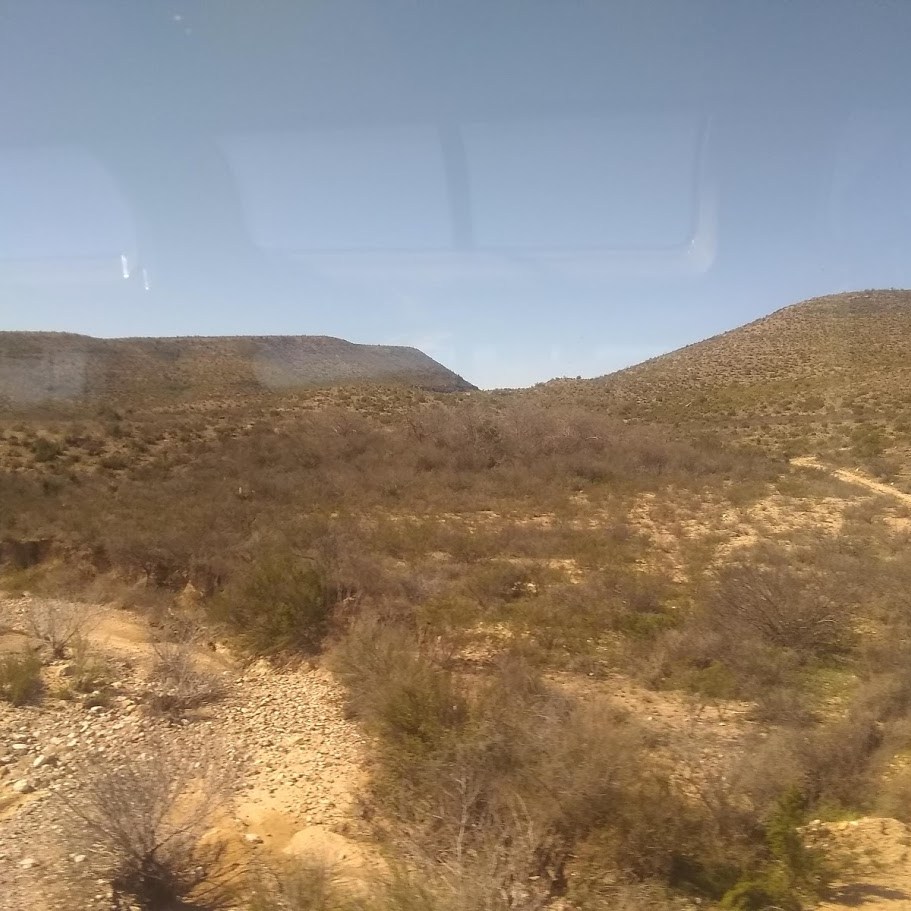
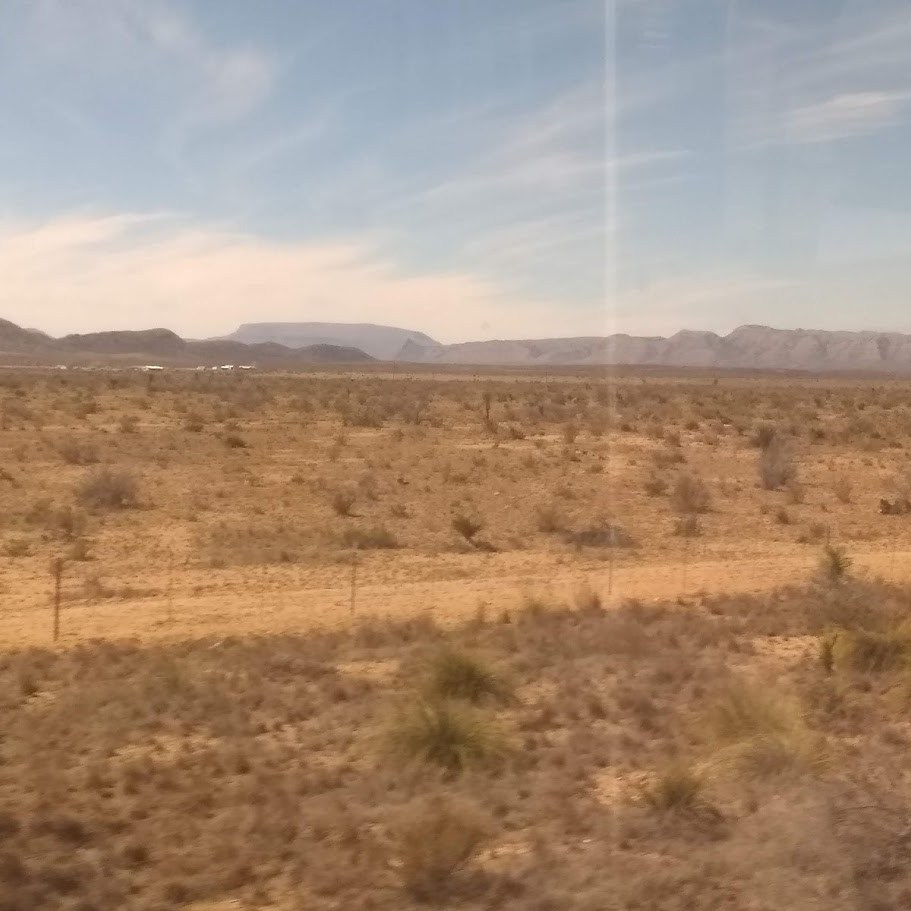
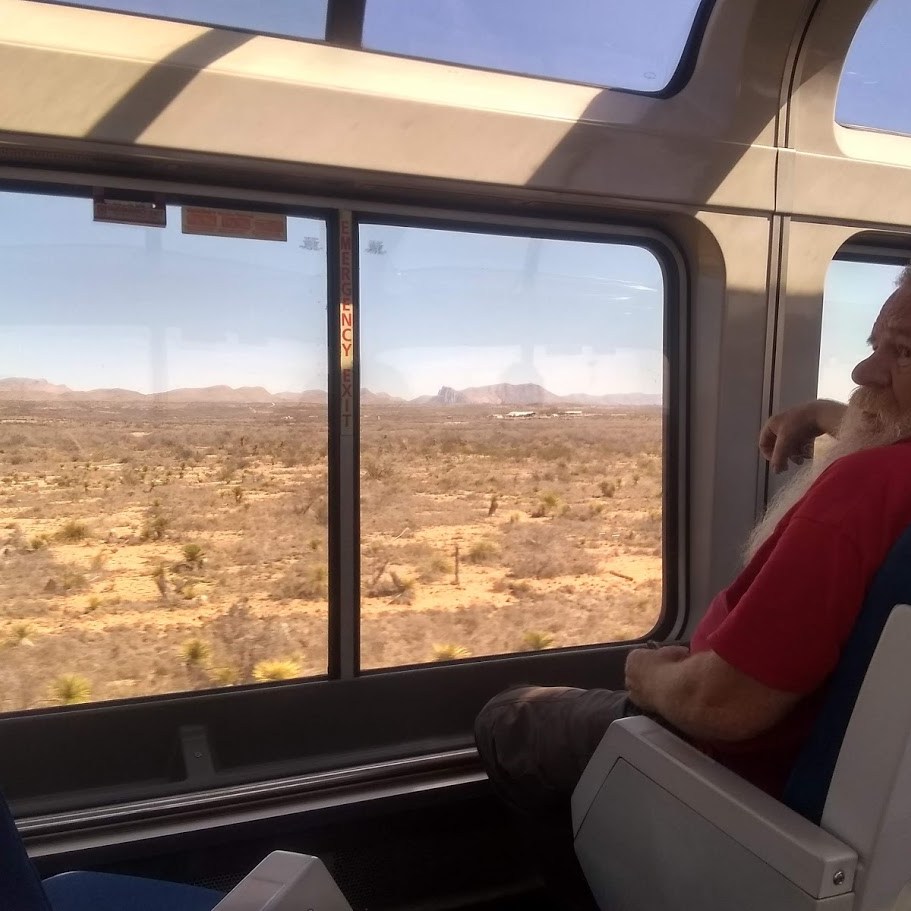

Clockwise from top left: west Texas, more west Texas, the Prada store about a mile outside Valentine TX, more west Texas and George (who gave me the book of maps) looking out the window of the Amtrak tourist carriage.
I knew it was most unlikely I would ever again have the time or inclination to spend twelve hours on a train looking at west Texas, so I bit the bullet and hit off on my first Amtrak journey, from San Antonio to El Paso. Because the train line was constructed in the nineteenth century, the towns and trading posts it served are mostly gone now and what’s left is some of the most desolate landscape I have ever seen. Really, the only variation is the land’s occasional transition from arid to semi-arid. The lifelessness of what’s on offer is such that the sight of an animal or cluster of houses elicits a sympathetic (and subconscious) sigh at the isolation they surive in. There was no grass as we know it, as in, covering an expanse of ground. Rather, the landscape was dotted with tufts of hardened vegetation. In the distance, the terrain rose and fell; hills and mountains could be seen, but nothing lush or conventionally beautiful; just more yellowed ground. Whereas one usually wonders what the view would be like from such peaks, in west Texas a summit would reveal more of the same vast nothingness. And yet, because I was looking at scenery such as I had never seen before, or was unlikely to see again, it was one of the most awesome trips I’ve ever taken. If, like me, you’re not in a hurry and you’re happy out with Spotify and a good book, I couldn’t recommend riding the Amtrak heartily enough.
Though west Texas is for all the world like those westerns TG4 shows, towns and communities do exist – there’s just not many of them. The train, Sunset Limited, stops at a town called Alpine. Alpine is described on its website as being “in Far West Texas, but far from stranded” (which, if nothing else, is a distinct selling point) but rather than being an oasis in the desert, it was for me a reminder of just how much desert there is. From a train you peer into people’s back gardens, rather than at the well-tended frontage they want you looking at, and I was struck by the poor standard of housing (aged mobile homes and tumbledown shack-like housing, a pretty common sight in America’s south) and the abandoned look the towns had to them. Such conditions give an insight into why some people were willing to believe Trump’s rhetoric in 2016. I can only imagine that such isolated towns haemorrhage young people. And yet, such areas catch the eyes of the creative, for in the middle of nowhere I saw one of the strangest things ever I have seen; a Prada store standing utterly isolated on the side of the road outside Valentine – it was, I think, a pop-up art installation. Of all the journeys I took, I think this was the best journey because I got to see a bit of America that I knew nothing of, that I’d never seen on television or heard being discussed, or was never exposed to.
After twelve hours of endlessness, we finally pulled into El Paso. Along with the Mexican city of Ciudad Juarez, El Paso makes up a ‘binational conurbation’ on the US/Mexico border. One’s the second safest city in the US and the other was one of the most dangerous cities in the world there for a while. I stuck with the safe one. I hadn’t really intended staying in El Paso but after a brief walkabout, it was clear from the public art, newly-renovated (and charming) streetcars and the city’s tourist app that El Paso’s really trying to make itself into something. I thought then that it would be rude to shun such efforts so I basically guilted myself into staying two nights. I’m glad I did, but you don’t need to bother. The city is buzzing down at the border crossing end, with streets and stores that have the bustle of a market town, but in its centre it’s aged and there are remarkably few people around. I thought that a city like that, built as a trading outpost with such a colourful history of Mexican, native American and Anglo-American history, would be bursting at the seams with stories and culture but those stories aren’t really captured or displayed adaquetely. The museums are free though, every single person I met there was delightful and sure I’d done my bit for El Paso. Beto can thank me later.
I had done my tourist bit alright, but it was only later that I read of the appalling humanitarian conditions on El Paso’s outskirts; the holding facilities for migrants had been full to capacity, forcing many weary migrants to sleep under highway bridges on the outskirts of El Paso. I absolutely inhale newspapers usually but in El Paso I’d been glued to Anna Burn’s Milkman and with no car to drive around El Paso’s outer areas, I had completely sheltered myself from knowledge or appreciation of what was going on down the road. Riding the bus out of El Paso, it’s easy to distinguish which suburbs are those of Ciudad Juarez and those of El Paso – I noticed that alright. And I did see that the Greyhound station was bedlam, even by Greyhound station standards. The queues had been manic, the station was jammed and there were far more people there carrying considerable loads of belongings, exhausted. But, in my tourist bubble I had not put two and two together, i.e. that many of these people were migrants, making their way to new lives, carrying their belongings, shushing babies, feeding children and in transit for God knows how long. That the situation on the Mexican border and (in hindsight) El Paso’s role in that had gone completely over my head really got me wondering about the value of all this travelling I’ve been lucky enough to do. Like, I’m a far more open-minded and worldly person for it but if I could duck in and out of museums and sip coffee utterly ignorant of a humanitarian crisis down the road, then what am I really learning? I enjoy a good over-think, so many hours were knocked out of pondering that but at the time of writing I still haven’t an answer.
But sitting at home staring at the four walls didn’t teach me much either so I’ll keep going with the wandering and wondering. Should you find yourself, like me, with more money than sense, then Texas is a great place to offload both. It can feel like the land above Enid Blyton’s faraway tree sometimes – where everything’s massive except you – and that’s always a good point from which to reconsider the familiar. And though I pride myself of recognising and appreciating how lucky I am to be healthy, happy and capable of such travel, backpacking is no excuse for ignorance of others’ (often painful) reality and newspapers need to be read.
Yeehaw.
Said nobody I met in Texas, ever.

 doireann.ie